















High-Speed vs. High-Force Hydraulic Presses Comparison


In the contemporary sheet metal fabrication landscape, the selection of hydraulic press technology is no longer a simple matter of selecting a machine with enough tonnage to move metal. Modern manufacturing demands a sophisticated balance between throughput efficiency and mechanical power. As a mechanical engineer, I often see factory owners struggling to decide between high-speed hydraulic presses and high-force hydraulic presses. This choice dictates not only the types of parts a facility can produce but also the long-term profitability and energy footprint of the operation. High-speed systems focus on rapid cycle times and high-frequency production, while high-force systems prioritize the massive energy required for deep drawing, heavy forging, and thick plate manipulation. Understanding the nuances of fluid dynamics, pump configurations, and frame rigidity is essential for making an informed investment. This article provides a deep dive into the engineering principles that differentiate these two classes of machinery, ensuring that your selection aligns with your specific production objectives and material requirements.
Understanding the Basics of Hydraulic Press Dynamics
At its core, a hydraulic press operates on Pascal’s Principle, which states that pressure applied to a confined fluid is transmitted undiminished in every direction. In high-speed vs. high-force hydraulic presses, the application of this principle diverges in how the energy is channeled. A high-force press is designed to maximize the Pressure (P) and the Area (A) of the cylinder to generate massive output. Conversely, a high-speed press focuses on the Flow Rate (Q), ensuring that the fluid can fill the cylinder volume rapidly to achieve high ram velocities. While both machines use hydraulic oil as the medium, their internal components—such as pumps, valves, and accumulators—are optimized for either velocity or pressure. High-force machines typically feature larger cylinder diameters and heavy-duty frame constructions (H-frame or four-column) to withstand the intense internal stresses of heavy-tonnage operations. High-speed machines, often utilizing servo-hydraulic technology, emphasize reduced reciprocating mass and rapid valve response times to minimize ‘dead time’ during the press cycle.
Why This Topic Matters in Sheet Metal Fabrication
In the competitive world of contract manufacturing, cycle time is a direct indicator of profitability. However, cycle time cannot come at the expense of part quality. If a high-speed press is used for an application requiring sustained high pressure, such as deep drawing stainless steel, the machine may lack the ‘dwell’ capability or the structural stiffness to maintain uniform thickness. Conversely, using a slow, high-force press for simple blanking or light stamping leads to bottlenecking and high energy waste. The distinction between high-speed and high-force hydraulic presses is the difference between a sprinter and a weightlifter. In high-volume electronics or automotive trim production, speed is king. In heavy appliance manufacturing or structural aerospace components, force and precision under load are the primary drivers. Choosing the wrong configuration leads to premature tool wear, hydraulic fluid overheating, and structural fatigue in the press frame.
In the world of hydraulic engineering, power is the product of flow and pressure. You can optimize for one or the other, but trying to maximize both simultaneously requires a massive increase in energy consumption and system complexity.
Key Factors to Consider in Press Selection
When evaluating high-speed vs. high-force hydraulic presses, several technical factors must be analyzed:
- Cycle Frequency: High-speed presses are rated by strokes per minute (SPM). If your application requires more than 20-30 SPM, a high-speed or servo-hydraulic system is mandatory.
- Approach and Return Speeds: The actual forming time is often small compared to the time the ram spends moving to and from the workpiece. High-speed presses utilize rapid-traverse circuits to minimize this non-productive time.
- Tonnage Consistency: High-force presses are engineered to maintain peak tonnage throughout a longer stroke, which is vital for operations like extrusion or deep drawing.
- Heat Dissipation: High-speed operation generates significant heat due to rapid fluid friction. These systems require advanced cooling circuits and larger oil reservoirs.
- Frame Deflection: High-force applications put immense strain on the press bed and crown. The ‘spring’ of the machine must be calculated to ensure the die stays aligned under maximum load.
Technical Explanation and Engineering Calculations
To differentiate these machines, we must look at the mathematical relationship between force, speed, and power. The force (F) generated by a hydraulic press is calculated as: F = P x A, where P is the system pressure and A is the cross-sectional area of the piston. To increase force, you must either increase the pressure (requiring higher-rated hoses and seals) or increase the piston area (resulting in a larger, heavier machine). The velocity (V) of the ram is calculated as: V = Q / A, where Q is the flow rate from the pump. This creates an engineering trade-off: for a fixed flow rate Q, increasing the area A to get more force will automatically decrease the velocity V. To achieve both high speed and high force, the pump must provide a massive flow rate at high pressure, which follows the power formula: Power = (P x Q) / 600 (where P is in bar, Q is in L/min, and Power is in kW). This shows that a machine that is both high-speed and high-force will have a significantly higher motor wattage and energy cost. Engineers must calculate the ‘Specific Energy’ required for a part to determine if the extra investment in a high-power system is justified.
Comparison Table: High-Speed vs. High-Force Systems
| Fonctionnalité | High-Speed Hydraulic Press | High-Force Hydraulic Press |
|---|---|---|
| Primary Goal | Short cycle times (High SPM) | Maximum material deformation |
| Pump Type | Variable displacement or Servo-pump | High-pressure piston pumps |
| Cylinder Diameter | Smaller (for rapid filling) | Larger (for force multiplication) |
| Typical Tonnage | 50 to 300 Tons | 500 to 10,000+ Tons |
| Frame Style | C-Frame or Lightweight H-Frame | Heavy H-Frame or Pre-stressed Tie-rod |
| Common Use Case | Stamping, blanking, assembly | Deep drawing, forging, heavy plate bending |
Step-by-Step Guide to Selecting the Right Press
Step 1: Define the Work Envelope. Determine the maximum part size and the total stroke required. High-force machines usually offer longer strokes. Step 2: Calculate Required Tonnage. Use the formula Tonnage = (Length of Cut x Thickness x Tensile Strength) / 2000 for blanking, or specific deep-draw formulas. Step 3: Determine the Duty Cycle. How many parts per hour are needed? If the goal is 500 parts per hour, calculate the required ram speed. Step 4: Analyze Material Behavior. Some materials, like certain aluminum alloys, are strain-rate sensitive and may crack if formed too quickly, favoring a high-force press with controlled speed. Step 5: Evaluate Energy Costs. Calculate the idle time vs. the forming time. High-speed servo presses are much more efficient if there is significant dwell time between cycles.
Common Mistakes to Avoid
One of the most frequent errors is over-speccing tonnage ‘just in case.’ While having extra capacity seems safe, a 1000-ton press doing a 100-ton job is incredibly inefficient and lacks the ‘feel’ or speed required for light work. Another mistake is ignoring the ‘shock’ factor in high-speed blanking. When the material shears, the sudden release of energy can cause hydraulic shockwaves that damage valves; high-speed presses need specialized shock dampers. Finally, many buyers neglect the cooling system. A high-speed press running at 40 SPM generates massive thermal energy; without an oversized heat exchanger, the oil viscosity will drop, leading to internal leakage and loss of precision.
Precision is not just about the machine’s ability to reach a position; it is about the machine’s ability to maintain that position under the varying thermal and structural loads of a high-speed production environment.
Industry Applications
High-speed hydraulic presses are the workhorses of the consumer electronics and automotive connector industries. They are used to produce millions of small, precise brackets and shields where every second saved in cycle time translates to thousands of dollars in profit. On the other hand, high-force hydraulic presses are indispensable in the heavy industrial sector. For example, in the production of automotive chassis members or large propane tanks, the press must exert thousands of tons of pressure over a long stroke to draw the metal into its final shape without tearing. In the aerospace sector, high-force presses are used for ‘isothermal forging’ of titanium components, where the material must be moved slowly under extreme pressure to ensure a uniform grain structure. Understanding these applications helps in identifying which machine characteristic is the true priority for your facility.
Conclusion
Choosing between high-speed and high-force hydraulic presses is a strategic decision that impacts the core capabilities of your manufacturing facility. High-speed presses offer the agility and throughput necessary for high-volume, thin-gauge work, leveraging modern servo-hydraulic technology to minimize energy waste. High-force presses provide the raw power and structural integrity required for heavy-duty deformation, where the quality of the form is more important than the speed of the stroke. By carefully calculating your tonnage requirements, cycle time targets, and material properties, you can select a machine that optimizes your production flow and ensures a high return on investment. Whether you are stamping small precision parts or drawing heavy industrial components, the right hydraulic press is the foundation of a successful fabrication strategy.
FAQ
How does servo-hydraulic technology impact high-speed press efficiency?
Servo-hydraulic systems use a servo motor to drive the hydraulic pump directly, allowing for precise control of flow and pressure. This eliminates the need for energy-wasting proportional valves and allows the machine to consume almost zero energy during idle periods, significantly increasing efficiency in high-speed applications.
Can a high-force press be modified to run at higher speeds?
To some extent, yes, by installing larger pumps and higher-flow manifold blocks. However, the physical limitation is usually the cylinder size; larger cylinders require immense volumes of oil to move quickly, which can lead to excessive heat and fluid cavitation issues if the system wasn’t originally designed for it.
What is the impact of oil temperature on high-speed cycling?
As oil heats up, its viscosity decreases. In high-speed presses, this can lead to ‘slippage’ in the pump and valves, causing a loss of cycle consistency and positioning accuracy. Advanced high-speed presses use active temperature management to keep oil within a narrow 10-degree operating window.
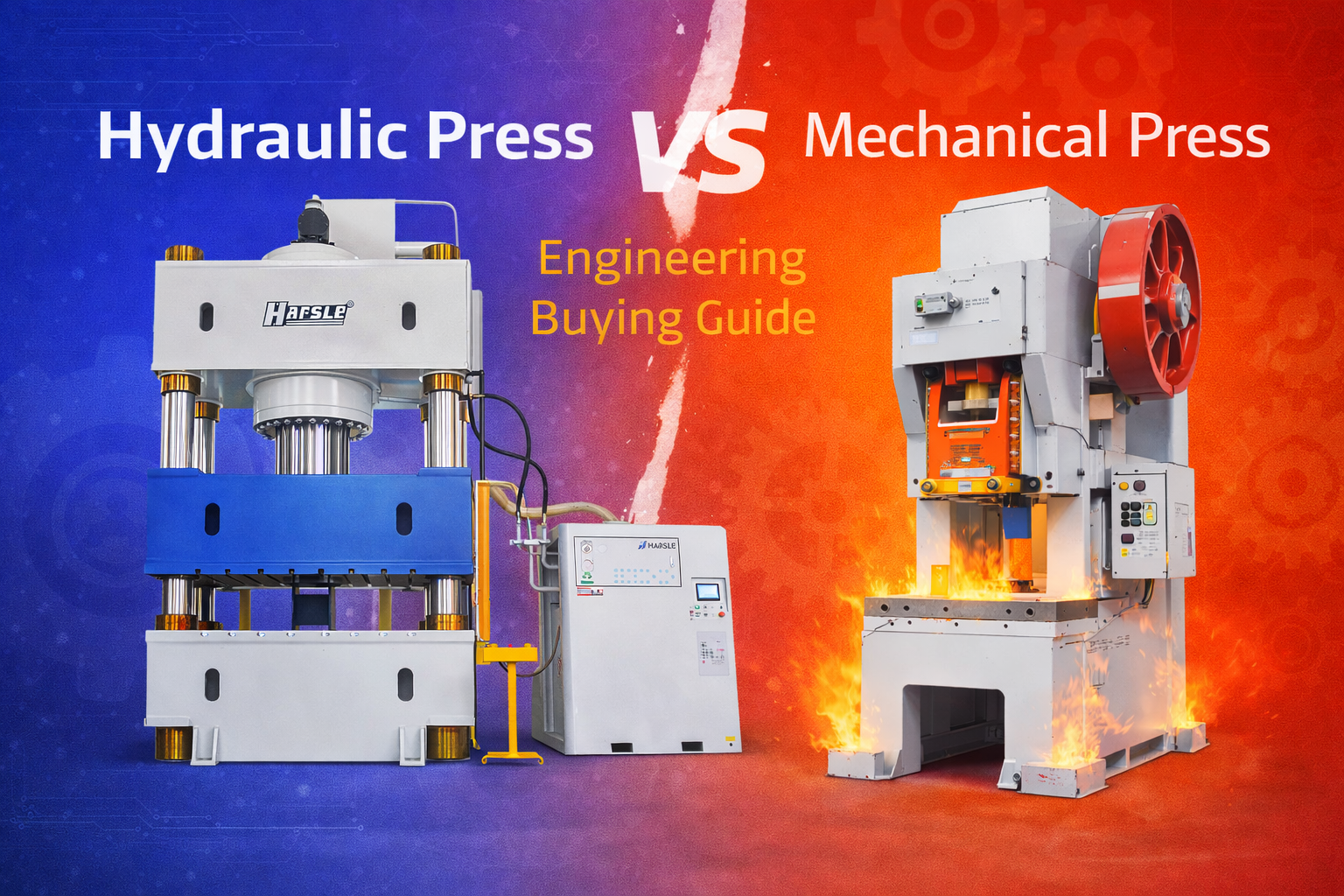
When should I choose a mechanical press over a high-speed hydraulic press?
Mechanical presses are generally faster than any hydraulic press for short-stroke blanking. However, a high-speed hydraulic press is preferred if you need full tonnage throughout the stroke, adjustable stroke lengths, or built-in overload protection that a mechanical flywheel cannot provide.
How does frame deflection affect high-force applications?
In high-force applications, the press frame can stretch or ‘yawn’ under load. If the deflection is uneven, it can cause the punch to enter the die at an angle, leading to rapid tool wear and part inaccuracies. High-force presses are engineered with lower deflection ratings (e.g., 0.001 inches per foot) to prevent this.