














The Importance of Guided Platens in Precision Pressing


In the realm of high-precision industrial manufacturing, the mechanical integrity of a press is defined not just by its tonnage capacity, but by the accuracy of its motion. Guided platens serve as the critical interface between the hydraulic or mechanical force generation and the tooling itself. For engineers and factory managers, understanding the nuances of how these platens maintain alignment under extreme pressure is essential for ensuring part quality and extending the lifespan of expensive dies. Guided platens are designed to resist lateral forces and maintain strict parallelism between the upper and lower bolster, a requirement that becomes increasingly difficult as sheet thickness and material tensile strength increase.
Understanding the Basics of Guided Platens
A guided platen is a robust plate, typically constructed from high-tensile steel or cast iron, that moves vertically within a press frame while being constrained by a guiding system. Unlike a standard ram that may rely solely on the cylinder rod for direction, a guided platen utilizes external structures—such as posts, columns, or gibs—to ensure that its path remains perfectly perpendicular to the bed. This setup is fundamental in precision pressing where even a few microns of deviation can result in shearing, uneven material thinning, or accelerated tool wear. The guiding mechanism acts as a rigid skeleton, absorbing the side-loading forces that occur during complex forming or asymmetrical blanking operations.
Precision is not an accident; it is the result of rigid mechanical guidance that counters the natural tendency of metal to resist deformation through eccentric loading.
Why Guided Platens Matter in Sheet Metal Fabrication
In modern sheet metal fabrication, the move toward high-strength low-alloy (HSLA) steels and complex geometries has placed unprecedented stress on pressing equipment. Without guided platens, the ram is susceptible to “ram tip” or angular deflection. When the punch contacts the workpiece, if the resistance is not perfectly centered, the resulting torque attempts to twist the ram. Guided platens prevent this by distributing the reaction forces through the press frame. This is particularly vital in progressive die applications where multiple stages of forming occur simultaneously across a long bed. If the platen tilts, the timing and depth of each stage are compromised, leading to rejected parts and potential damage to the press backgauge system or the dies themselves.
Key Factors to Consider in Guided Platen Design
When evaluating a press with guided platens, several technical factors must be scrutinized to ensure the machine meets the specific requirements of the application. These factors determine the machine’s ability to maintain dynamic parallelism under load.
- Number of Guide Points: Traditionally, presses use 4-post or 8-point gib guiding. More contact points generally equate to better resistance against off-center loads.
- Bearing Surface Material: High-performance systems often use bronze-impregnated graphite or hardened steel ways to reduce friction and heat buildup during high-speed cycling.
- Lubrication Systems: Automated thin-film lubrication is essential for maintaining the clearance between the guide and the platen, preventing galling.
- Platen Thickness: To minimize deflection (bowing) of the platen itself, the thickness must be calculated based on the maximum concentrated load it will experience.
Technical Analysis of Guided Platens and Load Distribution
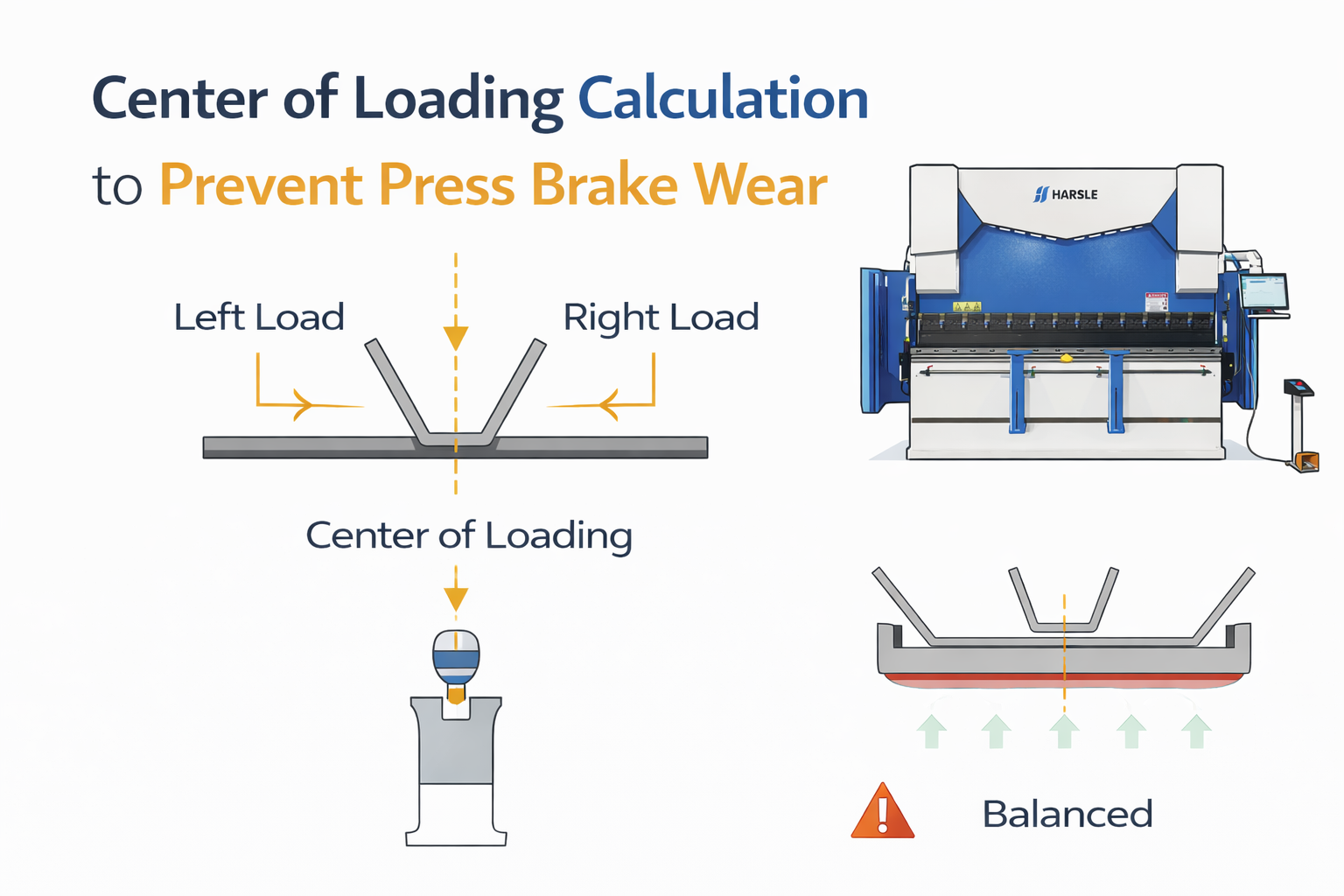
The primary engineering challenge in precision pressing is managing the moment created by eccentric loads. When the center of resistance from the workpiece does not align with the center of the press cylinder, a tipping moment (M) is generated. The formula for this moment is M = F * d, where F is the pressing force and d is the distance from the center of the press to the center of the load.
The guided platen must counteract this moment through the reaction forces (R) provided by the guides. If we assume a 4-post press with a distance (L) between the guides, the reaction force on the guides can be estimated as R = (F * d) / L. This calculation highlights why a wider guiding stance (larger L) is more effective at stabilizing the platen. Furthermore, the deflection of the platen itself can be modeled using a simplified beam deflection formula: Delta = (P * L^3) / (48 * E * I), where P is the load, L is the span, E is the Modulus of Elasticity, and I is the Area Moment of Inertia. Engineers use these calculations to ensure that the guided platen remains within the allowable parallelism tolerances (often specified in millimeters per meter).
Technical Data: Platen Material Comparison
| Material Property | 45# Carbon Steel | Cast Iron (G25) | Alloy Steel (42CrMo) |
|---|---|---|---|
| Tensile Strength (MPa) | 600 | 250 | 1080 |
| Modulus of Elasticity (GPa) | 210 | 110 | 212 |
| Damping Capacity | Low | High | Low |
| Hardness (HB) | 170-210 | 180-220 | 280-320 |
Comparing Different Types of Guided Platens Systems
There are two primary methods for guiding a platen: Post Guiding and Gib Guiding. Each has distinct advantages depending on the stroke length, tonnage, and required precision.
1. Four-Post (Column) Guiding
This system uses four precision-ground cylindrical columns. The platen travels on these columns using bushings. It is highly effective for deep-draw applications because it provides excellent clearance on all four sides of the press, allowing for easy material feed and part removal. However, it can be more sensitive to thermal expansion than gib-guided systems.
2. Gib Guiding (Box Way)
Gibs are adjustable rectangular or V-shaped tracks mounted to the press frame. This system is the gold standard for high-precision stamping. Because the gibs are adjustable, the clearance (running fit) can be set very tightly to minimize any lateral movement. 8-point gibbing, where the platen is guided on all four corners in two directions, offers the highest resistance to off-center loading.
Comparison Table: Post vs. Gib Guiding
| Caratteristica | Four-Post Guiding | Gib (Box Way) Guiding |
|---|---|---|
| Precision Level | High | Ultra-High |
| Off-Center Load Resistance | Moderate | Excellent |
| Adjustability | None (Replacement required) | Fully Adjustable |
| Maintenance | Simple (Lubricate columns) | Requires periodic shim/clearance check |
| Best Use Case | General forming, Die sets | High-speed stamping, Blanking |
Step-by-Step Guide to Selecting a Guided Platen Press
- Define Your Tonnage and Stroke: Determine the maximum force required and the distance the platen must travel.
- Calculate Eccentricity: Analyze your die layout. Will the center of the force be offset? If d > 10% of the bed width, prioritize 8-point gib guiding.
- Assess Material Sensitivity: For thin foils or micro-electronics, the tolerance for misalignment is nearly zero, necessitating ultra-rigid guided platens.
- Evaluate Maintenance Capabilities: If your facility lacks the staff to manually adjust gibs, a high-quality post-guided system with graphite-impregnated bushings may be more practical.
- Review the Frame Rigidity: A guided platen is only as good as the frame it is mounted in. Ensure the press frame has a high stiffness rating (low mm/m deflection at full load).
Common Mistakes to Avoid
One of the most frequent mistakes made by purchasing managers is selecting a press based on tonnage alone while ignoring the guiding specs. A 200-ton press with poor guidance will produce lower-quality parts than a 150-ton press with superior guided platens when off-center loads are present. Another common error is neglecting the lubrication of the guide bushings. Dry running leads to heat expansion, which can seize the platen or cause permanent scoring on the columns. Finally, engineers often overlook the “thermal growth” of the platen during high-speed operations; if the guiding system is too tight without thermal compensation, the platen can bind as temperatures rise.
In precision pressing, the guiding system does not just direct the motion; it preserves the investment you have made in your tooling and your brand reputation.
Industry Applications
Guided platens are ubiquitous in industries where part consistency is non-negotiable. In the **Aerospace industry**, they are used to form titanium skins where thickness variations can compromise structural integrity. In the **Automotive sector**, guided platen presses are essential for stamping structural pillars and battery enclosures for electric vehicles. The **Electronics industry** relies on them for high-speed micro-stamping of connectors, where the clearance between punch and die is often less than 0.01mm. Without the rigid control provided by guided platens, such precision would be physically impossible at scale.
Conclusione
The implementation of guided platens is a fundamental requirement for any precision pressing operation. By providing the mechanical rigidity necessary to resist off-center loads and maintain perfect parallelism, these systems ensure that the force generated by the press is applied exactly where it is intended. Whether choosing a four-post system for its versatility or an 8-point gib-guided system for its unmatched accuracy, engineers must prioritize the guiding mechanism as much as the hydraulic power unit. Investing in superior platen guidance results in longer tool life, reduced scrap rates, and the ability to tackle the most demanding material fabrication challenges in the modern industrial landscape.
FAQ
What is the difference between a moving platen and a guided platen?
A moving platen is any plate that travels to apply force, whereas a guided platen specifically refers to a plate constrained by external columns or gibs to maintain precise alignment and parallelism during its stroke.
How often should guided platen clearances be checked?
For high-precision gib-guided presses, clearances should be inspected every 2,000 operating hours or semi-annually. If you notice uneven burrs on stamped parts, an immediate check is required.
Can I upgrade a non-guided press to a guided platen system?
While technically possible through the installation of a die set with its own guide pins, retrofitting the press frame itself is usually cost-prohibitive compared to purchasing a purpose-built guided press.
What is the ideal clearance for gib-guided platens?
Typical industrial standards for precision presses suggest a clearance of 0.02mm to 0.05mm, though this depends on the press size, the lubricant used, and the operating temperature.
Why do guided platens help with tool life?
By maintaining perfect alignment, guided platens ensure that the punch enters the die with uniform clearance on all sides, preventing side-loading that causes chipping, dulling, and catastrophic tool breakage.