














The Science of Metal Deformation in Hydraulic Pressing Guide


Metal Deformation in Hydraulic Pressing is the cornerstone of modern industrial fabrication, bridging the gap between raw metallurgical science and precision component engineering. At its core, the process involves the application of controlled, immense force to alter the physical shape of a workpiece without adding or removing material. For mechanical engineers and factory managers, mastering this science is not merely about achieving a final shape; it is about managing the internal stresses, grain structures, and flow characteristics of alloys to ensure structural integrity and dimensional accuracy. Hydraulic presses offer a unique advantage in this field due to their ability to provide full tonnage throughout the entire stroke, allowing for more uniform deformation compared to mechanical alternatives. Understanding how materials transition from an elastic state to a plastic state under hydraulic pressure is essential for optimizing production cycles, reducing scrap rates, and extending the lifespan of expensive tooling. As industries move toward high-strength alloys and tighter tolerances, the technical nuances of deformation science become increasingly critical in maintaining a competitive edge in global manufacturing.
Understanding the Basics of Metal Deformation in Hydraulic Pressing
The fundamental principle of Metal Deformation in Hydraulic Pressing lies in the stress-strain relationship of the material being processed. When a hydraulic ram exerts force on a sheet or plate, the metal initially undergoes elastic deformation, where it will return to its original shape once the pressure is released. However, once the stress exceeds the material’s yield strength, it enters the realm of plastic deformation. In this phase, the atomic layers of the metal glide over one another along specific slip planes, leading to a permanent change in geometry. This process is governed by the dislocation density within the crystal lattice; as the metal is deformed, new dislocations are created, which eventually tangle and impede further movement, a phenomenon known as strain hardening or work hardening.
In hydraulic systems, the ability to maintain a constant pressure regardless of the ram position allows for more predictable plastic flow in complex geometries, especially during deep drawing operations.
Unlike mechanical presses that rely on a flywheel and crank mechanism, hydraulic systems utilize Pascal’s Law, which states that pressure applied to a confined fluid is transmitted undiminished in every direction. This allows for precise control over the deformation rate, which is vital for materials that are sensitive to strain rates. By adjusting flow valves, engineers can slow the deformation speed to allow for grain realignment, which prevents micro-cracking in less ductile materials.
Why Metal Deformation in Hydraulic Pressing Matters in Fabrication
In the context of industrial sheet metal fabrication, Metal Deformation in Hydraulic Pressing provides the versatility needed to handle a wide range of thicknesses and material types. The significance of this process is found in three key areas: precision, repeatability, and material efficiency. Because hydraulic presses can be programmed to stop at a precise pressure or position, manufacturers can achieve tighter tolerances than those possible with traditional hammer or manual forming methods. This precision is essential for components in the aerospace and automotive sectors, where even a fraction of a millimeter of deviation can lead to assembly failure or structural weakness.
Furthermore, understanding deformation allows for the use of thinner, high-strength materials. By calculating the exact amount of force required to achieve a specific radius, engineers can replace heavy mild steel components with lighter, high-strength low-alloy (HSLA) steels. This transition is only possible when the pressing parameters are carefully calibrated to account for the material’s unique deformation curve, ensuring that the part achieves its maximum strength-to-weight ratio during the forming process.
Key Factors to Consider
Several technical factors dictate the success of a pressing operation. Engineers must evaluate these variables before the first cycle begins:
- Material Ductility: The ability of the metal to undergo significant plastic deformation before rupture. This is often measured by percentage elongation.
- Yield Strength and UTS: The yield strength tells the engineer when permanent deformation begins, while the Ultimate Tensile Strength (UTS) indicates the point of material failure.
- Friction and Lubrication: The interface between the die and the workpiece generates heat and resistance. High-quality lubricants reduce the coefficient of friction, ensuring smooth material flow into die cavities.
- Grain Direction: Metals often exhibit anisotropy, meaning their properties differ depending on the direction of the rolling grain. Pressing ‘with’ or ‘against’ the grain significantly impacts bending allowance and risk of cracking.
- Dwell Time: The duration the ram remains at full pressure. In hydraulic pressing, dwell time can be used to set the material and reduce internal stresses.
Technical Calculations for Metal Deformation in Hydraulic Pressing
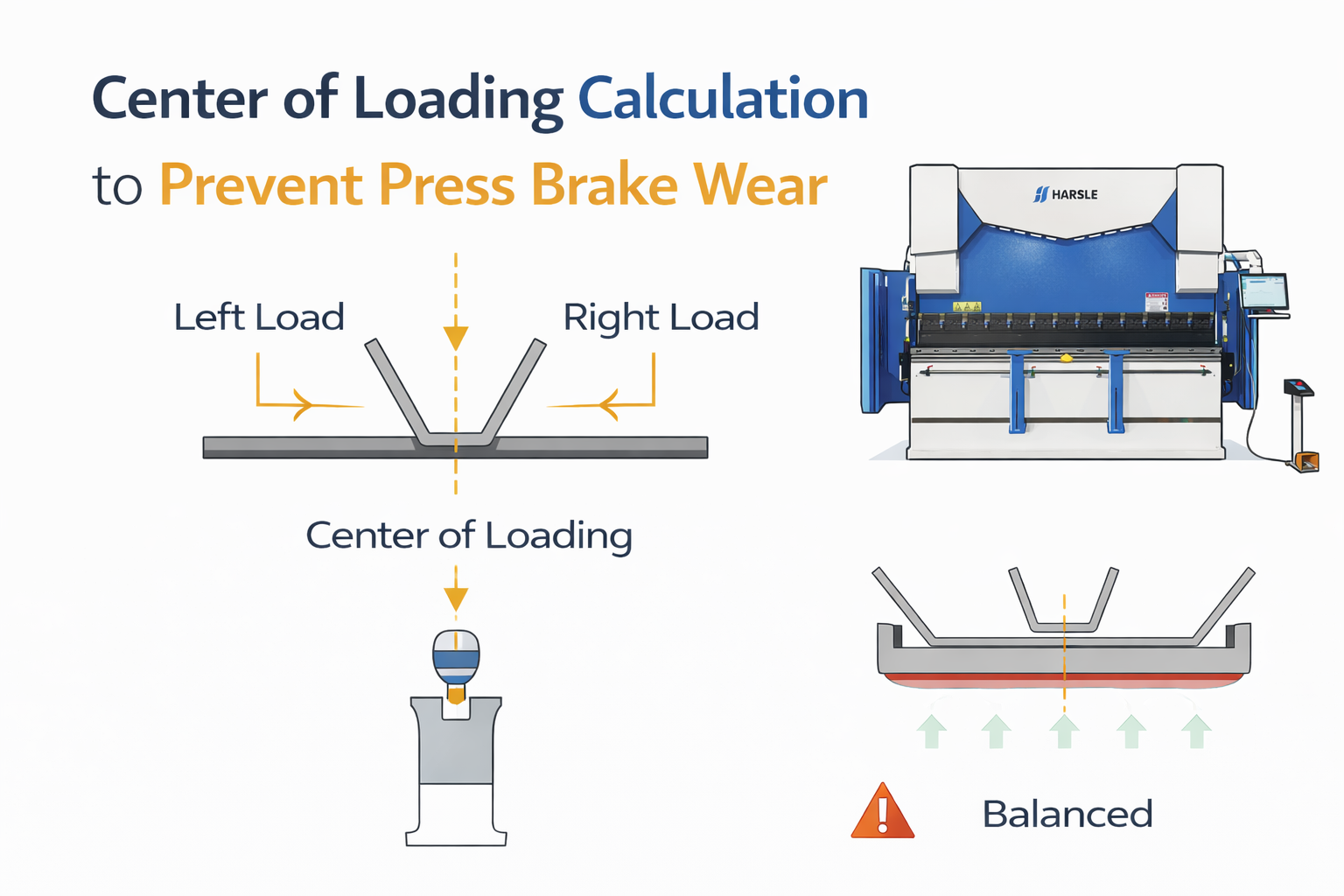
Predicting the force required for a successful operation is a critical engineering task. For a standard V-bending operation, the tonnage can be estimated using the following formula:
F = (K * L * t^2 * Sigma) / W
Where:
- F is the required force in tons.
- K is a constant (typically 1.33 for standard V-dies).
- L is the length of the bend in millimeters.
- t is the material thickness in millimeters.
- Sigma is the ultimate tensile strength (UTS) of the material in kg/mm2.
- W is the die opening width in millimeters.
Consider an engineering scenario: pressing a 3000mm long piece of 6mm thick Stainless Steel 304 (UTS approx. 52 kg/mm2) into an 48mm die. The calculation would be: F = (1.33 * 3000 * 36 * 52) / 48. This allows the operator to ensure the hydraulic press has the capacity to handle the load without overloading the hydraulic circuit or the frame structure.
Data Table: Typical Material Properties for Pressing
| Material | Yield Strength (MPa) | UTS (MPa) | Elongation (%) |
|---|---|---|---|
| Mild Steel (A36) | 250 | 400-550 | 20-25 |
| Stainless 316 | 205 | 515 | 40-60 |
| Aluminum 5052 | 193 | 228 | 12-18 |
Comparison of Hydraulic vs. Mechanical Pressing Methods
Choosing the right technology depends on the deformation requirements. Below is a comparison of the two primary technologies used in sheet metal fabrication.
| Особенность | Гидравлический пресс | Mechanical Press |
|---|---|---|
| Force Application | Constant throughout the stroke | Peak at the bottom of the stroke |
| Speed Control | Fully adjustable | Fixed (crank dependent) |
| Deep Drawing Capability | Excellent due to controlled flow | Limited by stroke velocity |
| Overload Protection | Built-in relief valves | Risk of frame damage if overloaded |
Step-by-Step Guide to the Pressing Process
- Material Verification: Confirm the thickness, grade, and grain direction of the sheet metal. Discrepancies here can lead to unexpected springback.
- Tooling Setup: Select the correct punch and die. Ensure the V-width is appropriate for the thickness (usually 8 times the material thickness).
- Pressure Calculation: Use the tonnage formula to set the machine’s pressure relief valves to the required force plus a 10-15 percent safety margin.
- Stroke Calibration: Set the upper and lower limits of the ram movement. For precision work, utilize the hydraulic press’s depth stop features.
- Trial Deformation: Perform a test press on a scrap piece. Measure the resulting angle or depth and check for ‘springback’—the tendency of the metal to return slightly to its original shape.
- Final Production: Execute the full run, monitoring the hydraulic fluid temperature, as viscosity changes can affect ram speed and consistency.
Common Mistakes to Avoid
Even seasoned engineers can fall into traps when managing Metal Deformation in Hydraulic Pressing. One of the most frequent errors is ignoring the impact of material springback. Every metal has an elastic modulus, meaning it will always recover slightly. Over-bending or using specialized ‘springback compensation’ software on the press controller is necessary to reach the target angle. Another mistake is poor lubrication in deep drawing operations; without it, the material may ‘gall’ or stick to the die, causing surface defects or tearing. Finally, neglecting the cleanliness of the hydraulic fluid can lead to valve stiction, causing the press to stutter and producing uneven deformation across the workpiece.
Industry Applications
The science of deformation finds use in countless sectors. In the automotive industry, hydraulic presses are used to form complex chassis components and body panels where consistent thickness is paramount. In the energy sector, thick-gauge plates are deformed into large-diameter pipes and pressure vessels. The aerospace industry relies on the slow, controlled deformation capability of hydraulic presses to shape exotic titanium alloys that would crack under the sudden impact of a mechanical press.
The transition from structural analysis to factory-floor execution requires a deep respect for the limits of the material being formed.
Заключение
Metal Deformation in Hydraulic Pressing is an intricate dance of force, material science, and fluid dynamics. By understanding the transition from elastic to plastic states, calculating tonnage requirements accurately, and choosing the right hydraulic parameters, manufacturers can produce components that are stronger, lighter, and more precise. As fabrication technology advances, the integration of CNC controls with hydraulic systems continues to push the boundaries of what is possible in metal forming, making it an indispensable part of the modern industrial landscape.
Часто задаваемые вопросы
What is the difference between elastic and plastic deformation?
Elastic deformation is temporary; the metal returns to its original shape when the load is removed. Plastic deformation is permanent, occurring after the material exceeds its yield strength.
How do I calculate the required tonnage for a hydraulic press?
Tonnage is typically calculated using the formula F = (K * L * t^2 * UTS) / W, where L is length, t is thickness, UTS is material strength, and W is the die opening.
What is springback and how is it managed?
Springback is the elastic recovery of the metal after the pressing force is removed. It is managed by over-bending the part by a few degrees or using CNC systems that compensate for material resistance.
Why is hydraulic pressing preferred for deep drawing?
Hydraulic presses allow for a constant speed and pressure throughout the entire stroke, preventing the material from tearing and allowing for more uniform wall thickness in deep shapes.
Does grain direction matter in metal deformation?
Yes, bending or pressing against the grain (perpendicular to the rolling direction) can often achieve a tighter radius without cracking, whereas pressing with the grain may lead to material failure.