













Powder Compaction Presses: Achieving Density and Uniformity

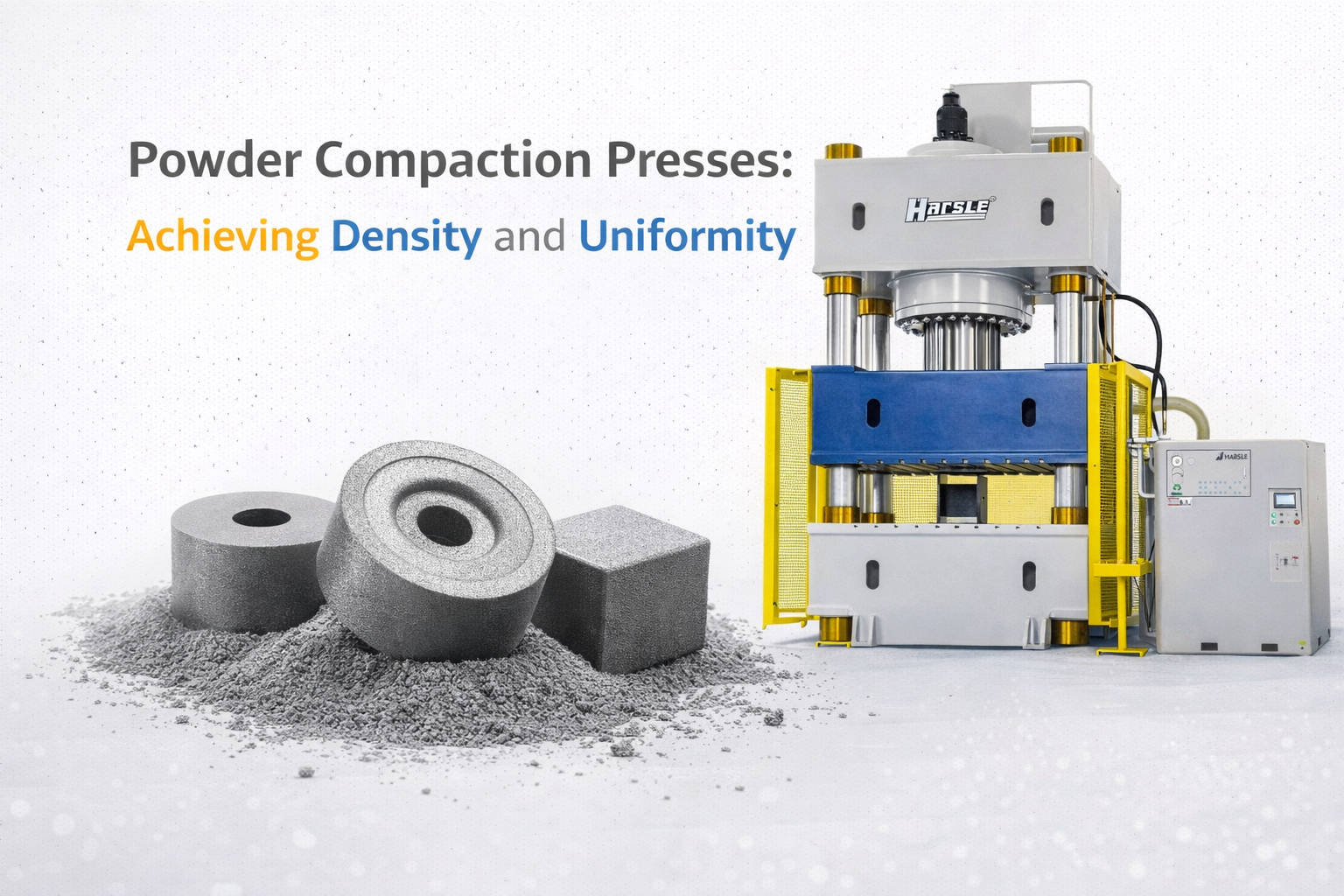
Powder compaction presses are the cornerstone of the powder metallurgy industry, providing the mechanical force necessary to transform loose metallic or ceramic powders into high-precision, structural components. In the realm of industrial manufacturing, achieving high density and uniformity is not just a goal—it is a technical requirement for ensuring the mechanical integrity of the finished part. These machines operate by applying significant uniaxial pressure to a die cavity filled with powder, creating a “green” part that possesses sufficient strength for handling before it undergoes the sintering process. As engineers and production managers seek to optimize their fabrication cycles, understanding the nuances of how powder compaction presses influence material properties is essential for reducing scrap rates and improving part performance.
Understanding the Basics of Powder Compaction
At its core, powder compaction is the process of compressing particulate matter into a solid form of specific geometry. Unlike sheet metal fabrication, where a solid blank is bent or cut, powder compaction builds the component from the ground up, particle by particle. The process begins with the die opening, which must be precisely engineered to account for material flow and the eventual contraction or expansion of the part. The compaction cycle involves three primary stages: filling, compression, and ejection. During compression, the air between particles is evacuated, and the powder undergoes elastic and plastic deformation. This creates mechanical interlocking and cold welding between the particles, resulting in a cohesive structure known as a green compact. The success of this process is measured by the green density, which is the ratio of the part’s mass to its volume before sintering.
Why Powder Compaction Presses Matter in Modern Manufacturing
In the competitive landscape of industrial part production, powder compaction presses offer a unique combination of high-volume efficiency and material conservation. Unlike subtractive manufacturing, where significant material is lost to shavings and offcuts, powder compaction utilizes nearly 100 percent of the raw material. This is particularly critical when working with expensive alloys or refractory metals. Furthermore, these presses allow for the creation of complex geometries that would be difficult or impossible to machine or cast with the same level of precision. The ability of the press to maintain consistent tonnage capacity across thousands of cycles ensures that every part meets the required density specifications, which directly translates to predictable tensile strength and hardness after heat treatment.
Uniformity in green density is not merely a quality metric; it is the fundamental precursor to dimensional stability and structural integrity during the sintering process.
Key Factors to Consider for Density and Uniformity
Achieving a high-quality compact requires the synchronization of several technical variables. The primary factor is the applied pressure, but it is not the only one. Material morphology, such as particle size and shape, significantly affects how the powder flows into the die. Spherical particles tend to flow better but may require higher pressures to interlock compared to irregular, dendritic particles. Another critical factor is the lubrication strategy. Internal lubricants, mixed directly with the powder, reduce friction between particles and between the powder and the die wall, which is essential for uniform pressure distribution. However, excessive lubrication can occupy space intended for the metal powder, actually limiting the maximum achievable density. The design of the backgauge system and the precision of the punch travel also dictate the final thickness and uniformity of the part.
Technical Explanation and Calculation of Compaction
To ensure a powder compaction press is correctly specified for a job, engineers must calculate the required tonnage and the compression ratio. The green density (ρ_green) is calculated as mass divided by volume. However, the compression ratio (CR) is more vital for tool design. It is defined as the ratio of the height of the loose powder in the die (H_fill) to the height of the final compacted part (H_compact). The formula is expressed as: CR = H_fill / H_compact. This ratio typically ranges from 2:1 to 3:1 for most metallic powders. To calculate the required press tonnage (T), the formula is: T = (A * P) / 2000, where A is the projected surface area of the part in square inches and P is the compaction pressure in pounds per square inch (psi). For example, if a part has a surface area of 4 square inches and the material requires 40 tons per square inch (tsi) for optimal density, the press must be capable of delivering at least 160 tons of force.
Comparison of Powder Compaction Presses Technologies
Selecting the right press depends on the complexity of the part and the required production speed. The following table compares the three most common drive systems used in modern powder compaction.
| Press Type | Układ napędowy | Main Advantage | Precision Level |
|---|---|---|---|
| Mechanical Press | Eccentric or Cam | High-speed production | Moderate |
| Prasa hydrauliczna | Fluid Power | Flexible stroke/high force | High |
| Servo-Electric Press | Servo Motors | Energy efficiency and control | Extreme |
Mechanical presses are often preferred for simple, high-volume parts due to their fast cycle times. Hydraulic presses, however, provide better control over the compression speed and are capable of maintaining pressure for a set dwell time, which is beneficial for complex parts that require air to escape. Servo-electric presses represent the latest advancement, offering the ability to program the punch position to within microns, which is essential for multi-level parts requiring different density zones.
Step-by-Step Guide to the Compaction Process
- Powder Preparation: Metallic powders are blended with lubricants and binders to ensure uniform flow and adequate green strength.
- Die Filling: The feed shoe moves over the die opening, filling it with a precise volume of powder based on the calculated fill height.
- Compression: The upper and lower punches enter the die. In double-action pressing, both punches move simultaneously to ensure the neutral axis of compression is in the center of the part, improving density uniformity.
- Decompression: The punches slightly retract to allow for the relief of internal stresses, preventing cracking during the next stage.
- Ejection: The lower punch rises to push the green compact out of the die cavity, while the feed shoe often pushes the part onto a conveyor for the next process.
Common Mistakes to Avoid with Powder Compaction Presses
One of the most frequent errors in powder compaction is ignoring the phenomenon of “springback.” When the compaction pressure is released and the part is ejected from the die, it will slightly expand elastically. If the die design does not account for this expansion, the part may exceed dimensional tolerances or develop micro-cracks. Another mistake is improper tool clearance. If the gap between the punch and the die wall is too large, powder can leak out, leading to flashing and loss of density. Conversely, if it is too tight, it can cause excessive wear and even galling. Engineers must also ensure that the press tonnage capacity is not consistently pushed to its absolute limit, as this can lead to frame deflection, which compromises the parallelism of the punches and results in non-uniform parts.
The key to longevity in powder compaction tooling is the precise management of the clearance between the punch and the die, balanced against the elastic recovery of the specific material being pressed.
Industry Applications
Powder compaction presses are utilized across a wide array of high-stakes industries. In the automotive sector, they are used to produce oil pump gears, shock absorber components, and transmission parts that require high wear resistance. In the medical field, these presses create biocompatible implants with controlled porosity to encourage bone ingrowth. The aerospace industry relies on powder compaction for manufacturing turbine components from high-temperature superalloys. Each of these applications demands a specific balance of density and uniformity, proving that the press is not just a tool for shaping, but a critical instrument for material engineering.
Wniosek
The mastery of powder compaction presses is fundamental to the production of high-performance components in the modern industrial landscape. By understanding the relationship between material behavior, compression ratios, and press technology, manufacturers can achieve the density and uniformity required for the most demanding applications. Whether you are selecting a high-speed mechanical press for simple components or a precision servo-electric press for multi-level geometries, the focus must remain on technical accuracy and rigorous process control. As material science continues to evolve, the capabilities of these presses will remain the primary driver for innovation in near-net-shape manufacturing.
Często zadawane pytania
What is the difference between green density and theoretical density?
Green density is the density of the part immediately after compaction but before sintering. Theoretical density is the density the material would have if it had zero porosity. Most compaction processes aim for 85-95% of theoretical density.
How does compaction speed affect part quality?
Higher speeds increase production rates but can trap air within the powder, leading to laminations or cracks. Lower speeds allow air to escape, ensuring better density uniformity, especially in deep-fill parts.
Why is double-action pressing better than single-action?
Single-action pressing (pressing from one side) leads to a density gradient where the part is densest near the punch. Double-action pressing applies force from both ends, resulting in a more uniform density distribution across the part’s height.
What role does die lubrication play in the process?
Lubrication reduces the friction between the powder and the die walls, which lowers the force required for ejection and prevents the part from cracking during the ejection phase.
Can powder compaction presses be used for non-metallic materials?
Yes, these presses are frequently used for ceramics, carbon, and pharmaceutical applications, although the pressures and tooling materials differ based on the abrasive nature of the powder.