















Calculating Heat Dissipation in High-Cycle Presses: Guide

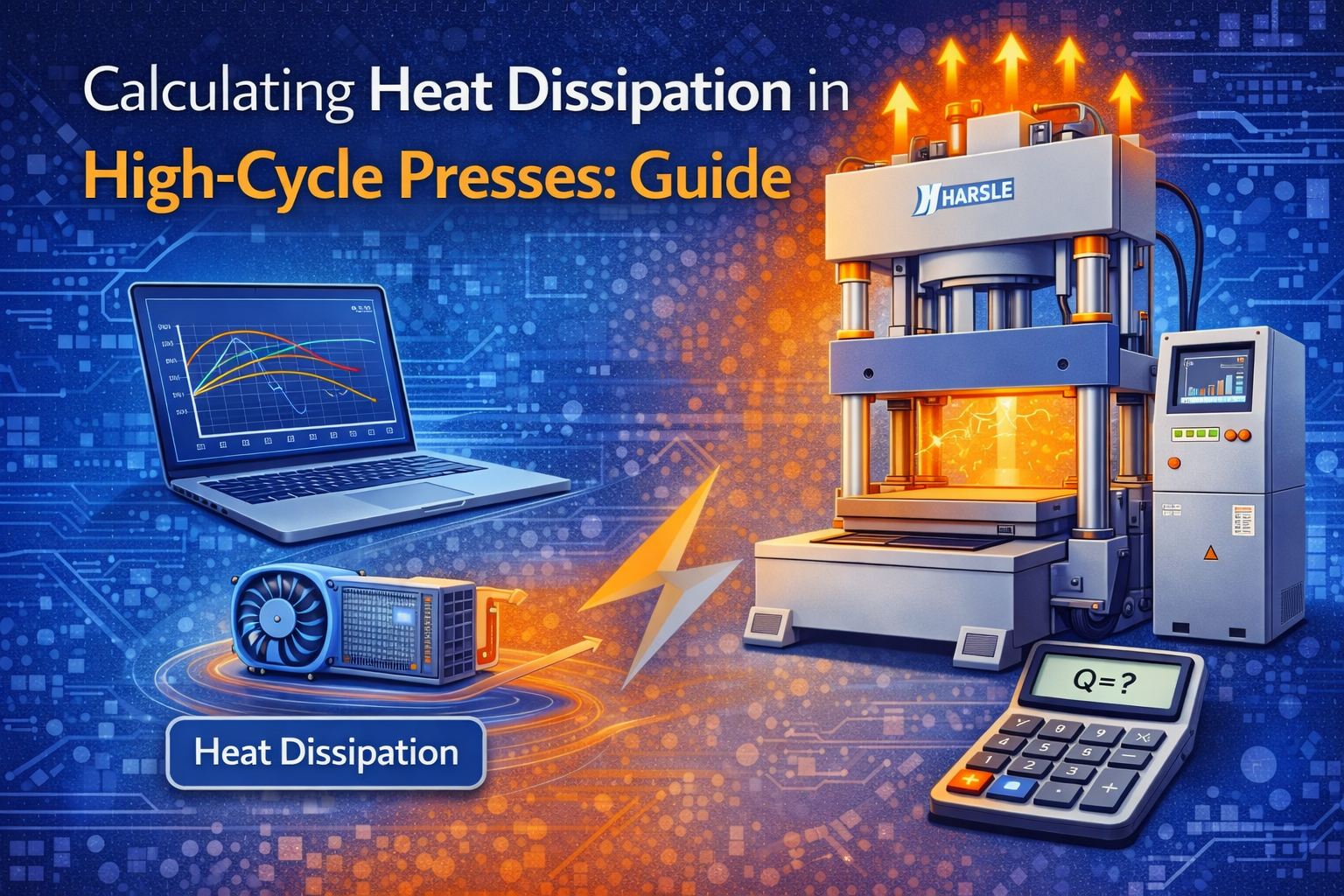
In the high-stakes environment of modern sheet metal fabrication, production efficiency is often limited not by a machine’s mechanical speed, but by its thermal stability. High-cycle presses, particularly those operating in the range of 400 to 1,200 strokes per minute, generate immense amounts of thermal energy. This heat is a byproduct of friction in mechanical linkages, hydraulic fluid shear, and electrical resistance in high-torque servo motors. Without precise thermal management, this energy accumulates, leading to oil viscosity breakdown, seal degradation, and thermal expansion that compromises part tolerances. Calculating heat dissipation in high-cycle presses is therefore not merely a maintenance task; it is a fundamental requirement for engineering a reliable production line. By understanding the thermodynamic interactions within the machine, engineers can implement cooling systems that ensure consistent shut height and prevent catastrophic component failure.
Understanding the Basics of Thermal Loads
To address heat dissipation, one must first understand where the energy originates. In a high-cycle press, the input energy is primarily used to deform the workpiece. However, a significant percentage of this energy—often between 20% and 40% depending on the drive type—is converted into heat rather than mechanical work. This conversion occurs through several mechanisms. In hydraulic systems, heat is generated when fluid passes through valves and orifices, a process known as fluid friction or shear. In mechanical presses, friction between the crankshaft, bearings, and gibs generates heat. Even in advanced servo presses, the eddy currents and resistance within the motor windings contribute to the thermal load.
Thermal management in high-speed stamping is the science of balancing energy input with energy extraction to maintain a steady-state temperature, ensuring that the machine frame expansion remains within a few microns of the target specification.
The term ‘high-cycle’ refers to the frequency of the work cycle. Because heat generation is cumulative, the time between strokes is insufficient for natural convection to cool the components. This leads to a rapid rise in the equilibrium temperature of the machine. The goal of thermal engineering in this context is to reach a ‘thermal steady state’ where the rate of heat generation ($Q_{gen}$) equals the rate of heat dissipation ($Q_{diss}$).
Why Calculating Heat Dissipation in High-Cycle Presses Matters
In the precision world of industrial manufacturing, thermal stability is synonymous with dimensional accuracy. When a press heats up, the metal frame expands. For a standard C-frame or straight-side press, a temperature increase of 10 degrees Celsius can cause several microns of expansion. In high-precision electronics stamping or automotive component manufacturing, this expansion can shift the bottom dead center (BDC) of the press, leading to inconsistent part dimensions or tool damage.
Furthermore, calculating heat dissipation in high-cycle presses is critical for fluid longevity. Hydraulic oil is designed to operate within a specific temperature range, typically 40 to 55 degrees Celsius. If the dissipation rate is poorly calculated, oil temperatures can soar, causing the oil to oxidize. Oxidized oil loses its lubricating properties and forms varnish, which clogs precision servo valves and destroys pump components. By accurately predicting heat loads, factory managers can size their chillers and heat exchangers correctly, preventing costly downtime and extending the mean time between failures (MTBF) for critical seals and bearings.
Key Factors Influencing Thermal Load
Several variables dictate the intensity of the thermal load in a high-speed fabrication environment. These must be quantified before any calculation can begin:
- Stroke Frequency: The most significant factor; heat generation increases linearly with strokes per minute (SPM).
- Tonnage Capacity: Higher tonnage requires more hydraulic pressure or mechanical force, which increases friction and shear.
- Material Thickness and Type: Harder or thicker materials require more energy for deformation, increasing the heat conducted from the workpiece back into the tooling.
- Dwell Time: The duration the press remains at the bottom of the stroke can affect how much heat is transferred from the drive system to the frame.
- Ambient Temperature: The delta between the machine temperature and the factory floor temperature dictates the rate of natural convection.
Technical Methods for Calculating Heat Dissipation in High-Cycle Presses
To accurately perform a thermal audit, we must calculate the total heat generated ($Q_{total}$). For a hydraulic press, this is often calculated based on the inefficiency of the pump system. The formula for hydraulic heat generation is expressed as:
P_heat = P_in * (1 – n)
Where:
- P_heat: Heat power generated (kW).
- P_in: Total input power to the motor (kW).
- n (eta): Total efficiency of the system (expressed as a decimal, e.g., 0.75 for 75%).
For high-cycle mechanical presses, we often look at the heat dissipation required for the lubrication system. The heat removed by the oil can be calculated using the mass flow rate formula:
Q = m * cp * dT
Where:
- Q: Heat dissipation rate (kJ/s or kW).
- m: Mass flow rate of the cooling oil (kg/s).
- cp: Specific heat capacity of the oil (typically around 1.8 to 2.2 kJ/kgK).
- dT: The temperature difference between the oil entering the heat exchanger and the oil exiting it.
The following table provides typical heat generation rates for various press types operating at 80% capacity:
| Press Type | Standard Efficiency | Heat Load (% of Motor Power) | Typical Dissipation Method |
|---|---|---|---|
| Hydraulic (High-Speed) | 65% – 75% | 25% – 35% | Water-Cooled Exchanger |
| Servo-Mechanical | 85% – 92% | 8% – 15% | Active Air or Liquid Cooling |
| Pneumatic-Hydraulic | 70% – 80% | 20% – 30% | Air-Cooled Exchanger |
Comparing Cooling Systems: Air vs. Water
Choosing the right dissipation method depends on the results of the calculations mentioned above. While natural convection occurs constantly, it is rarely sufficient for high-cycle applications. Forced cooling is mandatory.
| Tính năng | Air-Cooled (Radiator Style) | Water-Cooled (Shell and Tube) |
|---|---|---|
| Installation Cost | Lower | Higher (requires chiller/tower) |
| Cooling Efficiency | Moderate (Ambient dependent) | High (Precise control) |
| Maintenance | Simple (Dust cleaning) | Complex (Scaling/Chemicals) |
| Best For | Low to Mid-Cycle Presses | Continuous High-Cycle Stamping |
Water-cooled systems are generally preferred for high-cycle presses because water has a much higher specific heat capacity than air. This allows for a more compact heat exchanger design while removing massive amounts of energy. However, if the factory environment is prone to high humidity or extreme cold, air-cooled systems may be utilized to avoid condensation or freezing issues within the internal machine passages.
Step-by-Step Guide to Heat Load Assessment
To effectively manage Calculating Heat Dissipation in High-Cycle Presses, follow this engineering workflow:
- Data Collection: Record the input power, average strokes per minute, and actual tonnage used during a 1-hour production run.
- Determine Efficiency Loss: Consult the machine manufacturer for the efficiency curve (eta) at the specific operating pressure and speed.
- Calculate Q_gen: Use the input power and efficiency loss to find the kilowatts of heat being dumped into the system.
- Measure Temperature Delta: Use thermal sensors to measure the temperature of the oil reservoir and the temperature at the bearings or valves.
- Size the Heat Exchanger: Select a cooling unit that can dissipate 1.2 times the calculated Q_gen to account for ambient temperature spikes during summer months.
- Verify Fluid Velocity: Ensure the cooling fluid (water or oil) is moving at a velocity that maintains turbulent flow within the heat exchanger to maximize heat transfer.
A common rule of thumb for industrial engineers: If you cannot keep your hand on the hydraulic reservoir comfortably (approx. 50-55°C), your dissipation system is likely undersized for your cycle rate.
Common Mistakes in Thermal Management
Even with advanced calculations, several errors frequently occur in industrial settings. One major oversight is ignoring the ‘Heat Soak’ effect. After a machine is turned off, the heat trapped in the internal castings can migrate to the surface, causing localized thermal expansion that can seize bearings upon the next startup. Engineers often fail to keep the cooling pumps running for a 15-minute ‘cool-down’ period after production stops.
Another mistake is neglecting the impact of the die itself. In high-cycle applications, the die sets can act as a massive heat sink, drawing heat from the workpiece and transferring it directly to the press ram. If the die is not also cooled, it can become a primary source of thermal instability, regardless of how well the press’s internal oil is cooled. Finally, many purchasing managers undersize chillers by basing requirements on ‘average’ production speeds rather than ‘peak’ high-cycle bursts, leading to thermal trips during high-output shifts.
Industry Applications for High-Performance Cooling
The necessity of Calculating Heat Dissipation in High-Cycle Presses is most evident in high-speed laminations for electric vehicle (EV) motors. These presses run at incredible speeds to produce thousands of thin steel laminations. A variation of even 2 microns in the shut height can result in a defective motor stack. In this industry, presses are equipped with multi-stage water cooling systems that regulate the temperature of the oil, the motor, and the machine frame separately.
In the beverage packaging industry, high-cycle cupping presses utilize massive heat exchangers to handle the thermal load of continuous 24/7 operation. These systems often integrate the press cooling with the building’s central HVAC or cooling tower system to recycle the thermal energy, demonstrating a shift toward sustainable industrial thermal management. In each of these cases, the difference between a profitable operation and a maintenance nightmare lies in the accuracy of the initial heat dissipation calculations.
Phần kết luận
Managing the thermal environment of high-cycle presses is a multifaceted engineering challenge that requires a deep understanding of thermodynamics and fluid mechanics. By accurately calculating heat dissipation in high-cycle presses, manufacturers can ensure that their equipment operates within the optimal temperature window, protecting both the machine and the quality of the finished product. As stroke rates continue to increase in the pursuit of higher throughput, the role of active thermal management will only become more critical. Engineers must move beyond reactive cooling and embrace proactive thermal modeling to stay competitive in the modern sheet metal fabrication landscape. Investing in the right cooling infrastructure today prevents the costly thermal-related failures of tomorrow.
Câu hỏi thường gặp
How does oil viscosity affect heat generation in high-cycle presses?
Higher viscosity oil creates more internal friction (fluid shear), which increases heat generation. However, if viscosity is too low due to overheating, it fails to lubricate, leading to mechanical friction and even higher heat loads.
Can I use ambient air to cool a 500 SPM press?
Generally, no. Ambient air cooling is rarely sufficient for 500+ SPM applications due to the low heat transfer coefficient of air. Forced liquid cooling (water or oil-to-water) is typically required to maintain thermal stability.
What is the ideal operating temperature for high-speed press oil?
The ideal range is 40°C to 50°C (104°F to 122°F). Exceeding 60°C significantly accelerates oil oxidation and seal failure.
How does thermal expansion affect the Bottom Dead Center (BDC)?
As the press frame heats up, it elongates. This elongation moves the ram further down, effectively lowering the BDC and increasing the force applied to the tooling, which can cause part thinning or tool breakage.
Is it better to cool the oil or the machine frame directly?
Both are necessary in high-precision work. Cooling the oil protects the drive system, while ‘thermal shielding’ or cooling the frame with water jackets ensures dimensional accuracy of the press stroke.