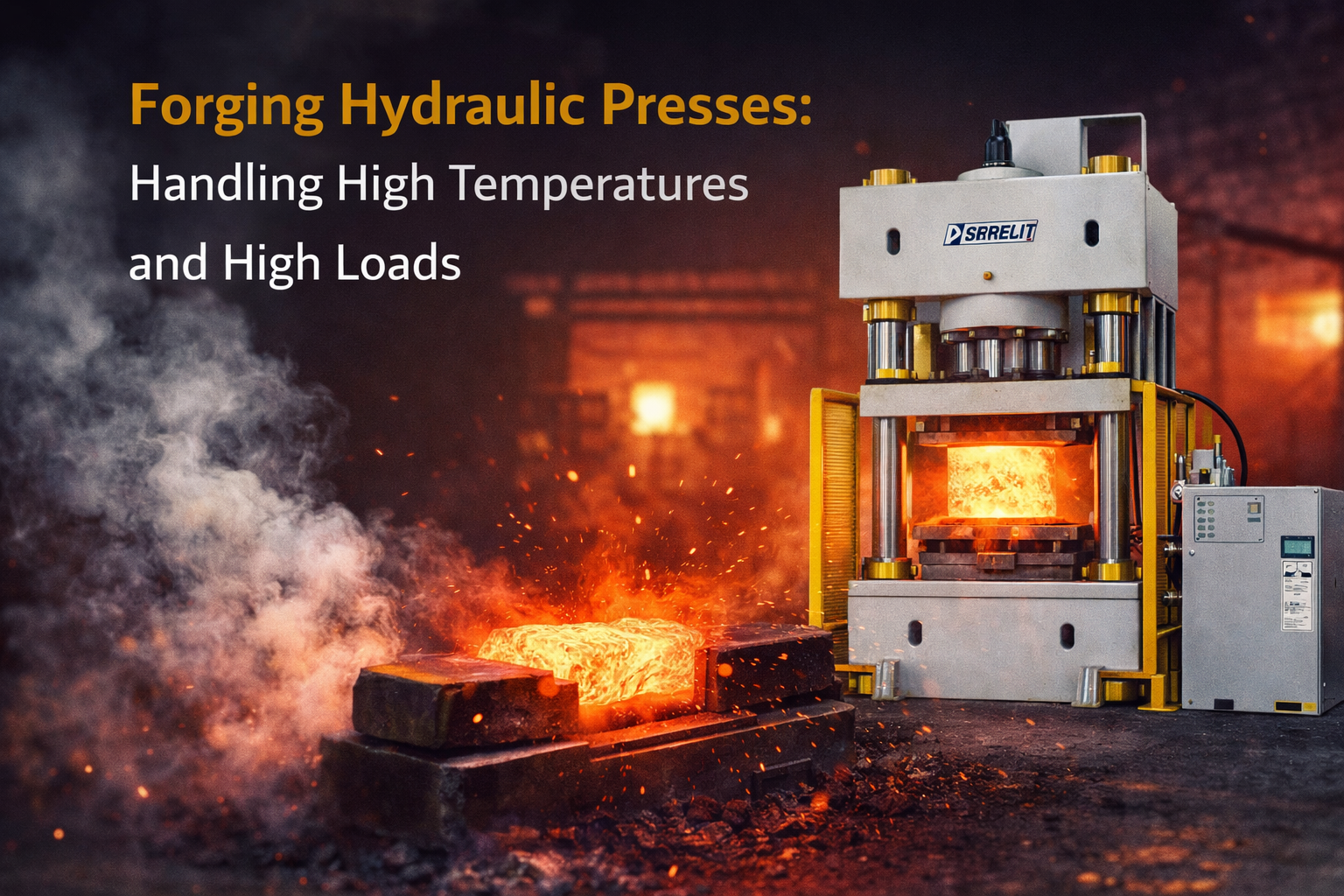
















Forging Hydraulic Presses: Handling High Temperatures and High Loads


Forging hydraulic presses represent the pinnacle of heavy industrial engineering, serving as the backbone for manufacturing high-strength components in the aerospace, energy, and automotive sectors. Unlike standard sheet metal machinery, a forging hydraulic press must withstand the dual challenges of extreme thermal radiation—often exceeding 1,200 degrees Celsius—and massive compressive loads that can reach tens of thousands of tons. The ability to maintain structural integrity and hydraulic precision under these conditions is what separates a standard industrial press from a dedicated forging powerhouse.
Understanding the Basics of Forging Hydraulic Presses
At its core, a forging hydraulic press utilizes Pascal's Principle to generate immense force through fluid pressure. In a forging environment, these machines are typically categorized into two types: open-die forging and closed-die (impression) forging. Open-die presses use flat or simple-shaped dies to deform the metal without completely enclosing it, while closed-die presses utilize precision-machined cavities to create complex geometries. The defining characteristic of these machines is their "dwell" capability, allowing them to apply consistent pressure over a set duration, which is essential for uniform grain refinement in the workpiece.
The efficiency of a forging hydraulic press is not merely measured by its maximum tonnage, but by its ability to maintain that force consistently while managing the thermal expansion of its critical components.
Why Handling High Temperatures and High Loads Matters
In sheet metal fabrication, we often discuss bending radius and die opening for cold processes. However, in forging, the material is heated to a plastic state to reduce its yield strength. While this makes the metal easier to shape, it introduces significant technical hurdles:
- Material Integrity: Consistent temperature and load control ensure the internal grain structure of the forged part is optimized for fatigue resistance.
- Tooling Longevity: High thermal loads can cause rapid wear and deformation of the dies if the press does not incorporate proper cooling and lubrication cycles.
- Machine Accuracy: Heat transfers from the workpiece to the press ram and bed, causing thermal expansion. If not managed, this leads to misalignment and loss of dimensional accuracy in the final product.
Key Factors to Consider in Forging Press Design
Engineering a press for high-temperature and high-load environments requires a focus on four primary pillars: frame rigidity, hydraulic fluid stability, thermal insulation, and control precision.
1. Frame Rigidity and Tonnage Capacity
The frame must be designed to resist deflection under maximum tonnage capacity. Most high-capacity forging presses utilize a pre-stressed tie-rod construction. This design ensures that the columns remain in compression even when the ram applies maximum force, significantly improving the fatigue life of the machine.
2. Thermal Management Systems
To protect the hydraulic system and the mechanical structure, specialized heat shields and water-cooling systems are integrated into the platens. Active cooling of the hydraulic oil is also mandatory to prevent viscosity breakdown, which would otherwise lead to seal failure and loss of pressure.
3. Hydraulic Seal Technology
High-temperature environments demand specialized seals made from Viton or PTFE-based composites. These materials maintain their elasticity and sealing properties even when the surrounding environment reaches temperatures that would melt standard nitrile seals.
Technical Explanation and Forging Force Calculation
Calculating the required force for a forging operation is more complex than a simple sheet metal bending calculation. In forging, the force required depends on the projected area of the part, the flow stress of the material at a specific temperature, and the friction between the die and the workpiece.
The simplified formula for forging force (F) is:
F = A × σ × K
Where:
- A: The projected area of the forging (in square millimeters or inches).
- σ (Sigma): The flow stress of the material at the forging temperature.
- K: A multiplication factor (usually 1.5 to 3.0) that accounts for friction and the geometry of the part (flash, corners, etc.).
For example, if you are forging a titanium alloy with a flow stress of 150 MPa at 950°C and the projected area is 50,000 mm², the base force required before accounting for friction would be 7,500 kN (approximately 765 tons). When accounting for complex die geometry (K=2.5), the required tonnage capacity jumps to 1,912 tons.
Comparison of Press Technologies
Selecting the right equipment depends on the production volume and the specific metallurgical requirements of the part. Below is a comparison of common forging machine types.
| Tính năng | Hydraulic Forging Press | Mechanical Crank Press | Screw Press |
|---|---|---|---|
| Force Application | Constant pressure | Peak force at bottom dead center | Impact energy |
| Stroke Control | Fully adjustable | Fixed stroke | Adjustable based on energy |
| Speed | Relatively slow | Very fast | Moderate |
| Load Management | Excellent for high loads | Risk of jamming at bottom | High impact stress |
| Best Use Case | Large, complex parts; Isothermal forging | High-volume small parts | Precision turbine blades |
Step-by-Step Guide to Operating Forging Presses Under Load
Managing a forging operation requires strict adherence to technical protocols to ensure safety and equipment longevity.
- Preheating the Dies: Never perform a high-load forging operation with cold dies. Dies should be preheated to 200°C–400°C to prevent thermal shock and cracking.
- Lubrication Application: Apply graphite-based or synthetic lubricants to the die surfaces to reduce friction and assist in part release.
- Hydraulic System Warm-up: Circulate the hydraulic oil until it reaches the optimal operating temperature (usually 40°C) before applying maximum tonnage capacity.
- Load Centering: Ensure the workpiece is centered under the ram. Off-center loading introduces eccentric forces that can damage the guide rails and seals.
- Post-Forging Cooling: Monitor the cooling rate of the forged part to prevent internal stresses or cracking, especially in high-alloy steels.
Common Mistakes to Avoid
Even experienced operators can encounter issues when dealing with the extreme variables of forging. Avoid these common pitfalls:
- Ignoring Oil Filtration: Forging environments are inherently dirty. Scale and dust can penetrate hydraulic systems, causing premature wear on valves and pumps.
- Overloading the Press: Attempting to forge a part that is too cold increases the material's flow stress, potentially exceeding the press's rated tonnage capacity and causing frame deformation.
- Inadequate Die Maintenance: Heat checking (fine surface cracks) is common in forging dies. Ignoring these cracks will lead to total die failure and potential damage to the press bolster.
Industry Applications
The capabilities of forging hydraulic presses are indispensable in several high-stakes industries:
- Aerospace: Forging of jet engine turbine disks and landing gear components using titanium and nickel-based superalloys.
- Energy: Manufacturing of large valve bodies for oil and gas pipelines and rotor shafts for wind turbines.
- Defense: Production of heavy-duty armored vehicle components and artillery breech blocks that require maximum structural density.
Phần kết luận
Forging hydraulic presses are complex machines that must balance brute force with surgical precision. Successfully handling high temperatures and high loads requires a deep understanding of thermal dynamics, hydraulic engineering, and material science. By selecting the right tonnage capacity, implementing robust cooling systems, and following strict maintenance protocols, manufacturers can ensure these industrial giants operate reliably for decades. For engineers and facility managers, the investment in high-quality forging equipment pays dividends in the form of superior product quality and reduced long-term operational costs.
Câu hỏi thường gặp
What is the best hydraulic oil for high-temperature forging presses?
Fire-resistant hydraulic fluids, such as water-glycol or synthetic phosphate esters (HFDU), are typically used in forging to prevent ignition in case of a leak near the hot workpiece.
How do I prevent thermal expansion from affecting press accuracy?
Modern presses use water-cooled bolsters and thermally insulated ram plates to limit heat transfer. Precise linear encoders with thermal compensation software are also used to adjust for minor expansions.
Why is dwelling time important in a forging hydraulic press?
Dwell time allows for the uniform distribution of pressure throughout the material, which is critical for achieving a consistent grain structure and eliminating internal voids in large forgings.
What are the signs of hydraulic seal failure due to heat?
Signs include erratic ram movement (judder), external fluid leaks at the cylinder head, and a drop in the press’s ability to maintain maximum tonnage capacity over time.
How often should forging dies be inspected?
In high-load environments, dies should be visually inspected every shift for heat checking or deformation, with more thorough NDT (Non-Destructive Testing) performed weekly to detect internal cracks.