
















Upgrading Safety Guards on Legacy Hydraulic Presses: Technical Guide

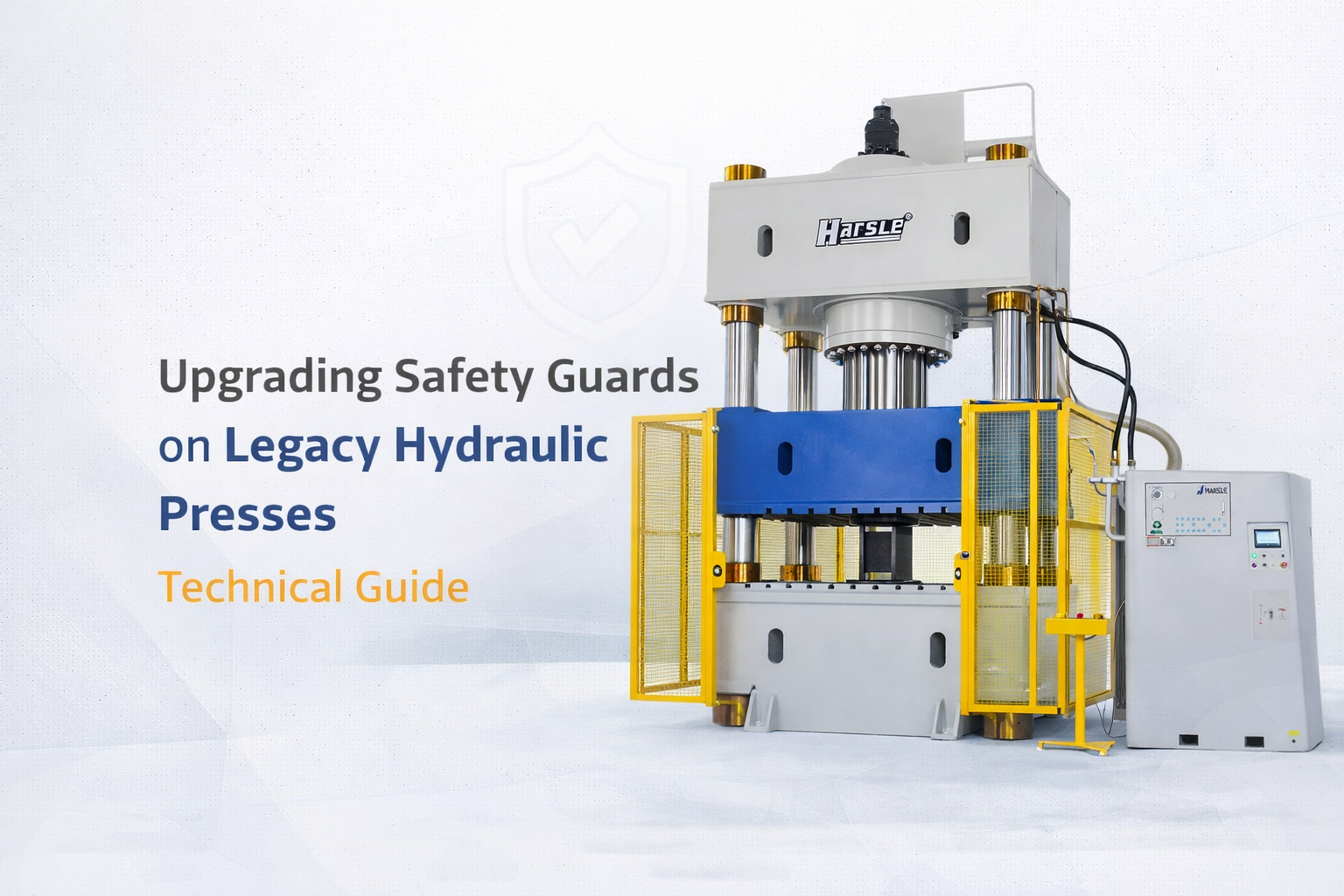
In the world of metal fabrication, hydraulic presses are known for their exceptional longevity. It is not uncommon to find machines built in the 1970s or 1980s still performing heavy-duty stamping and forming operations. However, while the structural frame and hydraulic cylinders of these legacy machines may remain robust, their safety systems often lag decades behind modern standards. Upgrading safety guards on legacy hydraulic presses is not merely a matter of compliance; it is a critical engineering intervention to protect human life and improve operational reliability.
The Challenge of Modernizing Vintage Equipment
Legacy hydraulic presses were often designed before the advent of sophisticated electronic monitoring and light curtains. Many rely on basic physical barriers or simple two-hand controls that may no longer meet the rigorous requirements of OSHA 1910.217 or ANSI B11.2. The primary engineering challenge lies in integrating modern, high-speed safety electronics with older, slower hydraulic valves and relay-based control logic. This article provides a comprehensive technical roadmap for engineers and plant managers tasked with modernizing these industrial workhorses.
Understanding the Basics of Hydraulic Press Safety
Before initiating an upgrade, it is vital to understand the inherent risks associated with hydraulic machinery. Unlike mechanical presses, which follow a fixed stroke defined by a crankshaft, hydraulic presses can be stopped or reversed at any point in the cycle. This flexibility is a benefit, but it also means the safety system must account for hydraulic fluid dynamics, pressure spikes, and potential valve failures.
Legacy safety guarding typically refers to any system installed prior to current Performance Level (PL) or Safety Integrity Level (SIL) standards. Common older methods included perimeter fencing or sweep guards. Modern safety philosophy shifts away from simple physical exclusion toward “active” protection, where the machine monitors its own state and the position of the operator simultaneously.
Why This Topic Matters in Sheet Metal Fabrication
Safety upgrades are a strategic investment for several reasons. First, the legal landscape has shifted. Regulatory bodies now demand that equipment meet current safety standards during any major rebuild or relocation. Second, the cost of a single workplace injury can far exceed the price of a complete safety retrofit, including medical costs, legal fees, and lost productivity.
“Safety is not a feature added to a machine; it is an integrated engineering discipline that defines the interaction between the operator and the kinetic energy of the press.”
Furthermore, modern safety systems like light curtains and laser scanners can actually increase throughput. By replacing bulky physical gates with invisible barriers, operators can load and unload parts more quickly, reducing the overall cycle time of the fabrication process.
Key Factors to Consider During an Upgrade
When planning a safety upgrade, several technical factors must be evaluated to ensure the system is effective and reliable:
- Control Reliability: The safety system must be designed so that a single failure within the components does not prevent the normal stopping action from taking place.
- Stopping Time (Ts): This is the total time it takes for the slide to come to a complete halt after a stop signal is given. On legacy machines, this is often slowed by aged hydraulic valves.
- Hydraulic Drift: Older cylinders may exhibit bypass leakage, causing the ram to drift downward when the machine is stopped. This must be addressed through counter-balance valves or mechanical locks.
- Environment: Hydraulic shops are often oily or dusty. Safety sensors must be rated (e.g., IP67) to withstand these conditions without false triggering.
Technical Explanation: Safety Distance Calculation
One of the most critical engineering tasks in upgrading safety guards is determining the “Safety Distance.” This is the minimum distance that a light curtain or presence-sensing device must be placed from the point of operation to ensure the press stops before an operator’s hand can reach the hazard zone.
The formula generally used, derived from OSHA and ANSI standards, is:
S = (K × Ts) + C
Where:
- S: The safety distance in inches.
- K: The hand-speed constant (standardized at 63 inches per second).
- Ts: The total stopping time of the machine in seconds (measured from the trigger of the safety device to the zero-motion state).
- C: The added distance based on the sensor’s resolution (depth penetration factor).
Example: If a legacy press has a measured stopping time of 0.25 seconds and the light curtain has a penetration factor of 3 inches, the calculation would be:
S = (63 × 0.25) + 3 = 18.75 inches.
Data Table: Common Safety Parameters for Hydraulic Presses
| Parameter | Legacy Standard | Modern Requirement | Impact on Safety |
|---|---|---|---|
| Valve Redundancy | Single Valve | Dual Monitored Valves | Prevents unintended descent if one valve fails open. |
| Control Architecture | Single Channel | Dual Channel (Cross-monitored) | Ensures fault detection in the electrical circuit. |
| Stopping Performance | Estimated | Measured and Validated | Required for accurate safety distance calculation. |
| Operator Interface | Foot Pedal only | Two-Hand Control + Light Curtains | Reduces the risk of accidental activation. |
Comparison of Guarding Technologies
Engineers must choose the technology that best fits the workflow of the legacy machine. The following table compares common retrofitting options:
| Technology | Pros | Cons | Best Use Case |
|---|---|---|---|
| Kurtyny świetlne | High productivity, easy access | Expensive, requires safety distance | High-volume stamping, manual loading |
| Hard Guarding | Low cost, absolute protection | Blocks visibility, slows loading | Long-run production, semi-automated cells |
| Interlocked Gates | High security, flexible access | Mechanical wear, slower than sensors | Maintenance access points, side/rear guarding |
| Laser Scanners | Programmable zones, floor mounting | Sensitive to dust/oil spray | Large presses, perimeter guarding |
Step-by-Step Guide to the Upgrade Process
Successfully retrofitting a legacy press requires a systematic approach to ensure no technical gaps remain.
- Initial Risk Assessment: Identify all hazards including trapping, crushing, and hydraulic failure modes. Document existing safety measures.
- Measurement of Stopping Time: Use a certified stop-time measurement device to determine the actual Ts. Do not guess this value.
- Hydraulic Circuit Audit: Evaluate if the press requires a safety block or redundant valves. Most legacy presses will need a new manifold to support monitored valves.
- Selection of Safety Controller: Choose a safety-rated PLC or a dedicated safety relay system that matches the required Performance Level (typically PLd or PLe for presses).
- Mechanical Installation: Mount light curtains or physical guards according to the calculated safety distance. Ensure mounts are rigid and vibration-resistant.
- Electrical Integration: Wire the safety devices into the emergency stop circuit. Ensure the system is “fail-safe.”
- Validation and Testing: Test the system under various load conditions. Perform a “pull-test” on all emergency stops and simulate sensor failures.
Common Mistakes to Avoid
During the upgrade of legacy equipment, engineers often fall into several common traps:
- Underestimating the Hydraulic Response: Many engineers focus on the electronics but forget that old hydraulic fluid or worn seals can significantly increase stopping times over time.
- Ignoring Side and Rear Access: While the front of the press is guarded, the sides and rear are often left open, creating “pass-through” hazards where a person can stand behind the light curtain.
- Incorrect Muting Setup: If using light curtain muting (disabling the sensor during the upstroke), it must be done with safety-rated limit switches or encoders. Improper muting is a major cause of bypass accidents.
- Lack of Documentation: Failing to update electrical schematics and hydraulic diagrams makes future troubleshooting nearly impossible and can lead to safety bypasses during repair.
Industry Applications
In the automotive industry, legacy hydraulic presses are frequently used for deep-drawing body panels. Upgrading these with multi-zone light curtains allows robots and humans to share the workspace safely. In the appliance sector, retrofitting 400-ton presses with laser area scanners has enabled faster die changes while maintaining 360-degree protection.
“Modernizing a legacy press is an exercise in bridging the gap between mechanical force and digital intelligence.”
Wniosek
Upgrading safety guards on legacy hydraulic presses is an essential evolution for any modern fabrication facility. By combining rigorous risk assessment with modern sensing technology and redundant hydraulic controls, manufacturers can extend the life of their capital equipment while ensuring a world-class safety environment. The investment in a technical retrofit pays dividends in compliance, worker safety, and long-term operational efficiency.
Często zadawane pytania
How do I determine if my legacy press needs a safety upgrade?
Perform a formal risk assessment. If the press lacks redundant hydraulic valves, control-reliable circuits, or modern presence-sensing devices (like light curtains) that meet current ANSI B11.2 standards, an upgrade is highly recommended.
What is the “stopping time” measurement in hydraulic presses?
It is the duration from the moment a stop command is triggered (e.g., breaking a light curtain beam) until the ram motion stops completely. This must be measured under the worst-case conditions (max speed and weight) to calculate the safety distance.
Can I install light curtains on a press with a foot pedal?
Yes, but the system must be integrated such that the light curtain remains active during the hazardous portion of the stroke. Proper safety logic must ensure the foot pedal cannot override the safety sensors.
What is the difference between Control Reliable and Standard control?
Control Reliable systems use redundant components and monitoring to ensure that a single component failure (like a fused relay contact) does not lead to a loss of safety functions, whereas standard controls do not have this redundancy.
How often should safety guards be inspected on older machines?
OSHA requires periodic inspections, but for legacy equipment, a daily pre-shift functional test of all safety devices (E-stops, light curtains, and interlocks) is considered best practice by most safety engineers.


