
















The History and Evolution of Hydraulic Press Technology

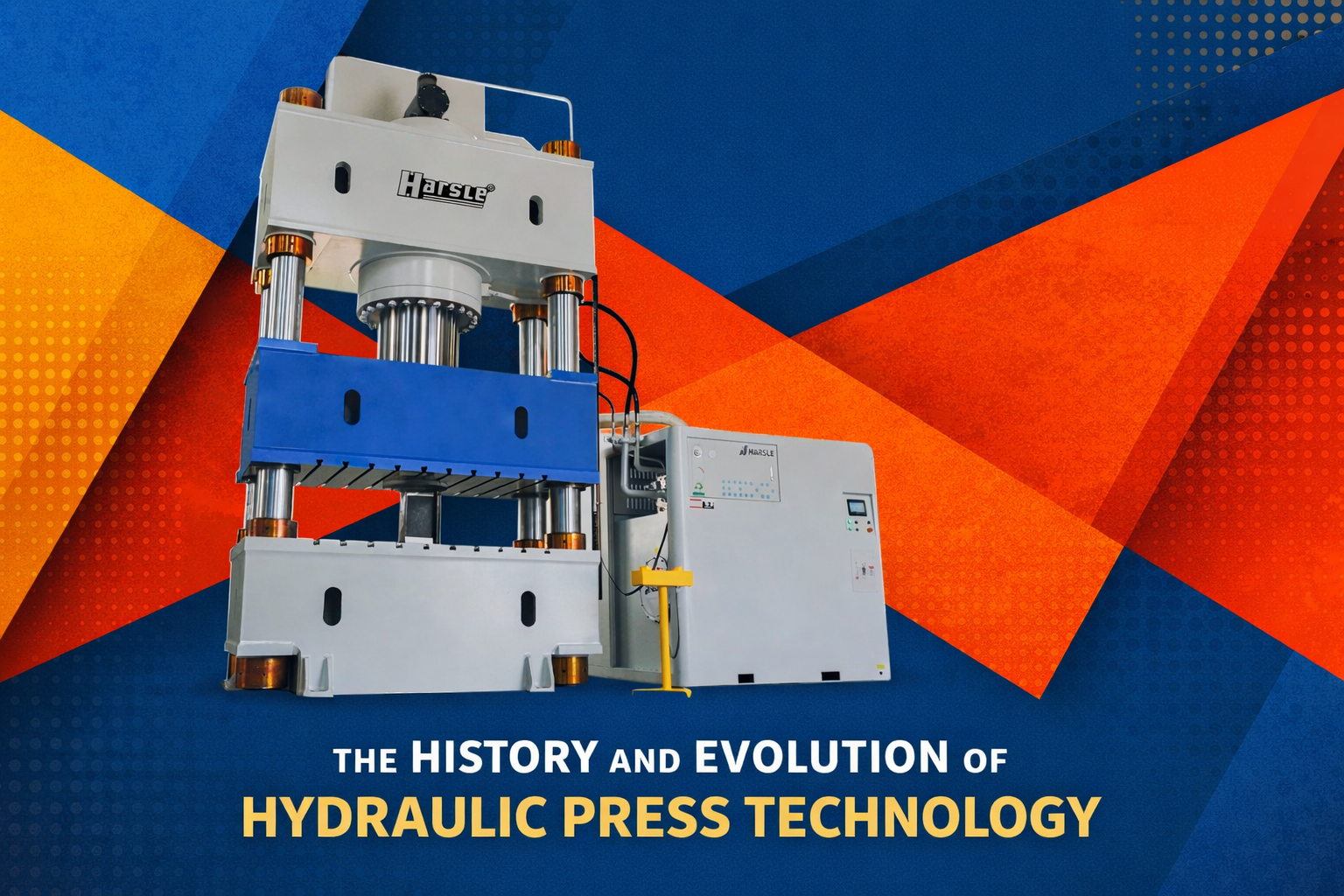
The history and evolution of hydraulic press technology represents a cornerstone in the advancement of modern mechanical engineering and industrial manufacturing. Since the discovery of fundamental fluid dynamics, the hydraulic press has transitioned from a rudimentary water-powered device into a sophisticated, CNC-controlled powerhouse capable of exerting thousands of tons of force with micron-level precision. For factory owners and engineers, understanding this progression is not merely a lesson in history; it provides critical insights into how modern tonnage capacity, stroke control, and energy efficiency have been optimized to meet the rigorous demands of aerospace, automotive, and heavy equipment sectors. Today, the hydraulic press is an indispensable tool in sheet metal fabrication, utilized for everything from simple punching to complex deep drawing and structural forming. Its ability to maintain consistent pressure throughout the entire stroke distinguishes it from its mechanical counterparts, a characteristic that was refined over centuries of trial and error. This article examines the technological milestones that shaped this equipment and provides the technical context necessary for making informed purchasing and operational decisions in a modern industrial environment.
The History and Evolution of Hydraulic Press Technology: From Steam to Fluids
To understand the history and evolution of hydraulic press technology, we must first look at the underlying physics. The technology is rooted in Pascal’s Principle, formulated by Blaise Pascal in the 17th century, which states that pressure applied to a confined fluid is transmitted undiminished in every direction. However, it wasn’t until 1795 that Joseph Bramah, an English inventor, patented the first functional hydraulic press. Initially referred to as the Bramah Press, this device utilized water as the hydraulic medium to multiply force, allowing a small manual input to generate significant output pressure. This early innovation solved a primary bottleneck in late 18th-century manufacturing: the need for massive, controlled force that manual or early mechanical leverage could not provide. Over the next century, the transition from water to mineral oil as the working fluid revolutionized the industry, reducing corrosion and improving lubrication within the cylinders. By the mid-20th century, the introduction of the high-speed pump and the solenoid valve transformed these machines from slow-moving giants into high-cycle-rate production units, setting the stage for the automated systems we use today.
Why the History and Evolution of Hydraulic Press Technology Matters for Modern ROI
In the context of modern sheet metal fabrication, the history and evolution of hydraulic press technology matters because it dictates the current capabilities of force management and energy consumption. Early presses were notoriously inefficient, with significant energy loss through heat and fluid leakage. Modern engineering has addressed these issues through the development of variable-frequency drives (VFDs) and servo-hydraulic systems. For a manufacturing plant, the evolution of this technology translates directly into Return on Investment (ROI) through several factors: first, the ability to handle a wider range of sheet thickness and material tensile strength; second, the integration of advanced safety features that comply with modern standards like ANSI B11.2; and third, the precision of the backgauge system and ram repeatability. Understanding the lineage of these machines helps engineers appreciate the transition from ‘dumb’ brute force to ‘smart’ controlled force, where every millimeter of the stroke is monitored by linear transducers and managed by PLC logic.
The transition from manual valve operation to closed-loop electro-hydraulic control has been the single most significant jump in the history of fluid power, enabling the precision required for modern aerospace components.
Key Factors to Consider in Hydraulic Press Evolution
Several technical milestones have defined the evolution of these machines. One of the most critical factors is the frame design. Early presses often suffered from frame deflection under high loads, which compromised the accuracy of the bending angle and the tool life. The move from simple cast frames to welded C-frame and H-frame (four-column) designs allowed for much higher tonnage capacity while maintaining structural rigidity. Another factor is the evolution of the hydraulic circuit. The shift from open-loop to closed-loop systems allows the machine to adjust pressure in real-time, compensating for variations in material thickness or tensile strength. Furthermore, the development of the hydraulic manifold reduced the number of external pipes and fittings, significantly decreasing the risk of leaks and system downtime. In today’s market, the ‘smart’ hydraulic press also includes predictive maintenance sensors that monitor oil temperature, contamination levels, and pump vibration, representing the latest stage in the history and evolution of hydraulic press technology.
Technical Explanation and Force Calculations
The core engineering principle of the hydraulic press has remained constant throughout its evolution, but our ability to calculate and control these forces has improved. The fundamental formula used to determine the force generated by a hydraulic press is based on the relationship between pressure and area. The basic formula is: F = P x A. In this equation, F represents the total force (tonnage), P represents the pressure generated by the pump (typically in PSI or bar), and A represents the surface area of the ram piston. For example, if a press operates at 3000 PSI and has a ram with an area of 50 square inches, the total force generated is 150,000 pounds, or 75 tons. When calculating requirements for a specific job, engineers must also consider the material tensile strength and the length of the bend. The formula for bending force in a V-die is: P = (1.42 x LTS x s^2 x L) / V. Here, LTS is the lower tensile strength of the material, s is the sheet thickness, L is the length of the part, and V is the die opening. The evolution of CNC controls allows these calculations to be performed automatically by the machine’s software, which then adjusts the proportional valves to deliver the exact required tonnage capacity.
| คุณสมบัติ | Early Hydraulic Presses (1800s-1920s) | Mid-Century Presses (1950s-1980s) | Modern CNC Presses (2000s-Present) |
|---|---|---|---|
| Fluid Medium | Water or crude oils | Standard mineral oils | Bio-degradable / Synthetic oils |
| Control Method | Manual levers / Valves | Relay logic / Early NC | CNC / Servo-Hydraulic / IoT |
| ความแม่นยำ | +/- 2.0 mm | +/- 0.5 mm | +/- 0.01 mm |
| Safety Systems | None / Basic guards | Light curtains / Dual palm | Integrated safety PLC / Laser monitoring |
| ประสิทธิภาพการใช้พลังงาน | Very Low (Constant run) | Moderate | High (On-demand servo) |
Analyzing the History and Evolution of Hydraulic Press Technology Comparisons
When comparing different pressing technologies, it is clear how the history and evolution of hydraulic press technology has carved out its own niche. Unlike mechanical presses, which rely on a flywheel and crankshaft to deliver energy in a fixed stroke, hydraulic presses offer full tonnage capacity throughout the entire travel of the ram. This makes them superior for deep drawing and forming processes where the material needs to flow into a die over a significant distance. However, in the late 20th century, the rise of servo-mechanical presses challenged hydraulic dominance in high-speed stamping. In response, hydraulic technology evolved to include ‘Hybrid’ systems. These hybrid presses use servo motors to drive the hydraulic pumps, combining the high force of hydraulics with the speed and energy efficiency of electric drives. This comparison highlights a key trend in manufacturing: the blurring of lines between different power transmission methods to achieve maximum versatility.
Comparison of Press Technologies
| Technology Type | Tonnage Delivery | Stroke Control | Best Application |
|---|---|---|---|
| Mechanical Press | Peak at bottom of stroke | Fixed by Crankshaft | High-speed stamping |
| เครื่องอัดไฮดรอลิก | Full force at any point | Fully adjustable | Deep drawing, Heavy forming |
| Servo-Hydraulic | Variable / Precise | High-speed dynamic control | Precision bending, complex parts |
| Pneumatic Press | Low force capacity | Limited control | Small assembly, light punching |
Step-by-Step Evolution of the Pressing Process
The process of utilizing a hydraulic press has evolved from a manual craft into a digital science. In the early stages of the history and evolution of hydraulic press technology, an operator would manually align the workpiece, engage a valve, and watch for visual cues to stop the ram. This process was fraught with inconsistency. The modern process follows a much more controlled sequence. First, the 3D model of the part is imported into the machine’s controller. Second, the software calculates the required bending radius and the corresponding die opening. Third, the backgauge system automatically moves to the programmed position with sub-millimeter precision. Fourth, the hydraulic system initiates a rapid approach, then switches to a slower pressing speed as it contacts the material to prevent ‘whip-up’ or cracking. Finally, the system performs a pressure-dwell phase to ensure the material takes the permanent set, followed by a controlled decompression to prevent hydraulic shock. This evolution has significantly reduced scrap rates and increased the safety of the fabrication floor.
Common Mistakes to Avoid in Hydraulic Press Selection
Despite the advanced state of the history and evolution of hydraulic press technology, many buyers still make critical errors during the selection process. One common mistake is over-specifying tonnage without considering the frame style. A C-frame press might offer the tonnage needed, but for precision work, the throat expansion (deflection) might be too high, leading to uneven bends. Another error is neglecting the ‘approach and return’ speeds. While the pressing speed is vital for the formation of the part, the speed at which the ram moves before and after the press cycle determines the overall throughput of the machine. Furthermore, many engineers fail to account for the heat generation in the hydraulic system. Without a properly sized heat exchanger or a modern variable-speed pump, the oil viscosity can drop during long shifts, leading to inconsistent performance and premature seal failure. Lastly, ignoring the compatibility of the machine’s CNC with existing factory software can lead to data silos and inefficient production workflows.
Industry Applications Across Decades
The applications for hydraulic presses have expanded dramatically as the technology evolved. In the 19th century, they were primarily used for baling cotton and extracting oils. During the world wars, the technology was pushed to its limits for forging artillery shells and aircraft skins. Today, the history and evolution of hydraulic press technology sees these machines at the heart of the electric vehicle (EV) revolution. Massive hydraulic presses are now used to form large structural components for EV chassis in a single stroke, a process known as ‘megacasting’ or large-scale structural forming. In the medical industry, small-scale precision hydraulic presses are used to form titanium implants with extreme accuracy. In the aerospace sector, the ability to maintain constant pressure over long dwell times is used in ‘hot forming’ of thermoplastic composites. These diverse applications prove that the hydraulic press remains one of the most versatile tools in the engineer’s arsenal, adapting to every new industrial challenge that arises.
Conclusion: The Future of Fluid Power
The history and evolution of hydraulic press technology is a testament to the enduring power of fluid dynamics in manufacturing. From Joseph Bramah’s first patent to the modern AI-integrated servo-hydraulic systems, the objective has remained the same: to deliver massive force with total control. For the modern manufacturer, the key is to balance the raw tonnage capacity of traditional hydraulics with the precision and efficiency of modern digital controls. As we move further into the era of Industry 4.0, we can expect hydraulic presses to become even more integrated, with real-time cloud monitoring and self-adjusting algorithms that can compensate for material variations before a single part is scrapped. For any organization looking to invest in new equipment, understanding this technical evolution is the first step toward selecting a machine that will remain productive and competitive for decades to come.
คำถามที่พบบ่อย
Who invented the first hydraulic press?
The first hydraulic press was patented by Joseph Bramah in 1795, based on the principle of fluid pressure transmission discovered by Blaise Pascal.
What is the main advantage of a hydraulic press over a mechanical press?
Hydraulic presses can deliver full tonnage capacity at any point in the stroke and have fully adjustable stroke lengths, whereas mechanical presses have a fixed stroke and peak force only at the bottom.
How does a servo-hydraulic system improve efficiency?
Servo-hydraulic systems use electric servo motors to drive pumps only when movement or pressure is required, reducing energy consumption by up to 70% compared to traditional constant-run pumps.
What is hydraulic shock and how is it avoided in modern presses?
Hydraulic shock is a pressure spike caused by rapid fluid movement stopping suddenly. Modern CNC presses use decompression cycles and proportional valves to ramp down pressure gradually.
Why did hydraulic presses switch from water to oil?
Oil replaced water because it provides better lubrication for internal components, prevents rust and corrosion, and has a higher boiling point, allowing for higher pressure and more stable operation.